
St. Paul Resident Lookup Records
A single name can point to very different St. Paul records. Ramsey County property data connects a taxpayer or owner to a parcel, its situs address, and a mailing clue. It does not establish who occupies the property. RecordEASE supplies the recorded-instrument trail. MNVotes answers a narrow registration-status question only after complete person and address details are entered. MCRO, vital indexes, and state filing tools answer other questions, each with its own access boundary.
| Record | What It Confirms | Where | Access |
|---|---|---|---|
| Property tax and value roll | Current taxpayer or owner clue, parcel, situs, and mailing information | Ramsey Property Tax and Value Lookup | Public; it does not prove occupancy |
| Recorded instrument | Grantor, grantee, transfer date, legal description, and related filing | RecordEASE | Fees and older index-book fallback apply |
| Voter status | A registration match and voting instructions for supplied details | MNVotes | Person-specific; public lists have statutory limits |
| Court case | Case number, party role, filing, status, and public docket material | MCRO | Remote public access, with counter fallback |
| Vital index | Marriage, birth, or death event leads | MOMS, MNHS, or MDH | An index is not a certified record |
Use the table as a question sorter. Ownership starts with the tax roll and deed trail. A registration question belongs in MNVotes, not in a parcel screen. A possible court match needs the case location, dates, and party role. Event research begins with the appropriate index, then moves to the office that has authority to issue a copy. That separation prevents an address clue from becoming an unsupported claim about a resident.
Verify a St. Paul Resident
A careful St. Paul resident lookup anchors a person to one specific record before it expands the search. Start with the strongest detail already known, such as a full name and former address, an approximate age, a spouse or relative, a business, or an event year. Preserve spelling variants. Then compare sources that were created for different purposes. An assessor result may connect a name to a PIN, while an MCRO result may separate a same-name party through county, case type, and filing date.
- Search the Ramsey property roll when the question concerns a taxpayer, owner, or parcel. Save the PIN, situs, legal description, and separate mailing address rather than relying on a name alone.
- Use MNVotes only with the complete first name, last name, birthday, and residence-address inputs it requires. A status result is not a searchable list of everyone at an address.
- Search MCRO with and without a middle initial, then test a permitted spelling variant, Ramsey County, and a date range. Compare party role, case number, and dates with the other record.
- Use MOMS, MNHS People Records, or MDH to confirm an event. Request a certified product only from the custodian and only when the eligibility rules allow it.
- Docket
- A court case’s running list of filings, hearings, orders, and other events. It is a case timeline, not a finding that every named party is the person sought.
- Index and image
- An index points to a record through fields such as a name, date, or number. An image is the scanned record itself and may be unavailable online or subject to fees.
- Certified copy
- A copy issued or certified by the lawful custodian for a defined official purpose. A public index entry cannot substitute for it.
Note: Record the source date and the fields that agreed before treating two records as the same person.
MCRO Name Checks in St. Paul
MCRO is Minnesota’s statewide public district-court portal. Its Name search accepts exact or Sounds Like searching, last, first, and middle names, date of birth, filing-date range, case category, status, and a county selection. A trailing wildcard can follow at least two characters in an exact-name search, but it cannot be combined with Sounds Like. Selecting Ramsey County can make a common name easier to review than an all-county search.
The remote result is not the official court record. It can show a case number, court location, case category, party names and roles, filing date, status, Register of Actions, event dates, document index numbers, public documents where available, and judgment detail where available. Public visibility of an address varies. Pending criminal matters are not returned by defendant name until the statutory conviction condition is met, and nonpublic or retained-out material may not appear.
The Minnesota BCA public criminal-history search is a separate official channel with required name and date-of-birth fields.
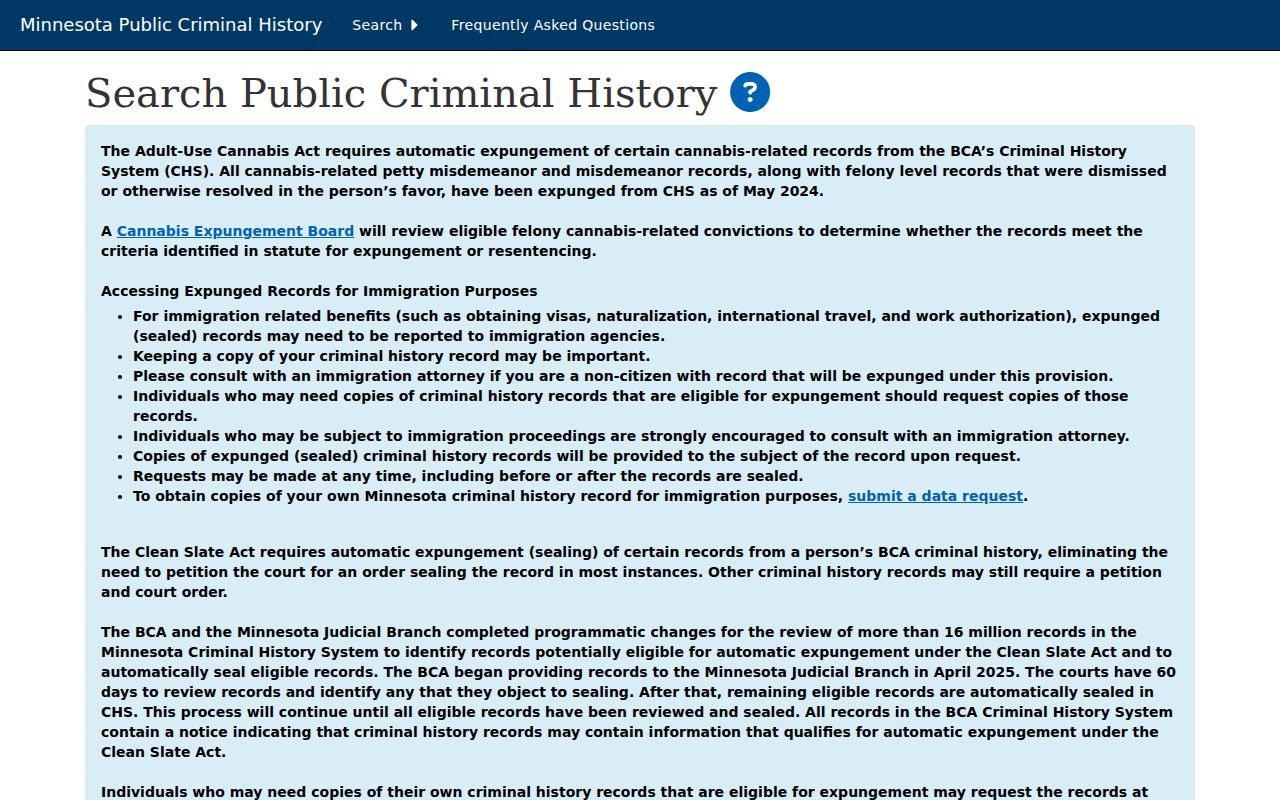
Use either system for the limited question it can answer, then verify a possible match through its custodian. Certified, exemplified, and plain copies, plus older-file questions, go through Ramsey Court Records. Public-access courthouse terminals can also expose material that the remote portal does not display.
St. Paul Vital Record Paths
Vital records have separate keepers and different levels of access. MOMS is a public marriage index. It can identify the county connected to a marriage, but the certificate comes from the county custodian. For a Ramsey marriage, the county vital-records office is the certificate route. Minnesota Historical Society People Records supplies searchable historical birth and death material, including birth records from 1900 through 1934 and death material through 2001, but its index does not become a certified record.
MDH maintains statewide birth records since 1900 and death records since 1908. Ramsey County offices can issue many products, while MDH handles forms by mail or fax and does not offer in-person service. All Minnesota death records are public for noncertified informational copies. Birth records have stricter classifications, including confidential data for some births and a 100-year public rule for otherwise inaccessible birth data. Certified birth and death records require an eligible requester, attestation, identification or an available alternative, or a qualifying court order.
For a possible same-name event, compare the date, county, certificate number, and related-name information when the index provides it. Do not turn a marriage index, obituary, or death entry into proof of a current address. When a certified product is needed, use Minnesota Vital Records or the responsible county office and follow the current form.
St. Paul Family-Reconnection Records
For an heir question, begin with a death index or obituary, then use MCRO to locate a public probate or will case. Public filings may identify a personal representative or heir. Older Ramsey estate research can also use the FamilySearch will collection for 1849 through 1887, subject to its access limits, and the local court counter. A recorded deed and newspaper notice can provide a second trail, but each fact still needs confirmation from the responsible office.
A former classmate search belongs with public institutional sources. Saint Paul Public Library yearbooks, school collections, library archives, and local newspapers may provide a name, class year, activities, or a historical address. MNHS’s Pioneer Press collection offers searchable local newspapers from 1861 through 1961. For a birth-parent or adoption question, do not use directories to bypass confidential records. The official route uses MDH adoption and birth-record rules, the Minnesota Fathers’ Adoption Registry where it applies, an adoption agency, or a court-directed confidential process.
Historical address work has its own sources. The St. Paul Directory Book keeps the city-directory collections separate from a one-person verification task, which helps preserve the difference between an annual listing and a current record.
St. Paul Business and License Links
A business filing or professional credential can confirm an official affiliation. It should not be treated as a resident address. Minnesota Secretary of State Business Filings allows business-name or file-number searching, including Begins With or Contains scope, active or inactive status, and prior-name options. The resulting record can show an entity’s filing history, named parties, and registered or principal addresses. Follow the entity’s records and do not assume that a registered agent lives at the business location.
The Minnesota Secretary of State business and liens portal supplies the filing routes used for those entity records.
The image reflects an official filing route, not a household directory. Copies and certificates may have charges, and older filings can take additional processing time. A current license question should go to the board or state licensing source responsible for that credential.
The Minnesota Board of Medical Practice practitioner search provides a board-specific way to check a credential by name, city, license number, specialty, or ZIP.
A credential result links a licensee to the public professional record. It does not settle identity when names match, and it does not establish a private household connection.
St. Paul Resident Lookup Limits
Minnesota’s public-data presumption has specific limits. Chapter 13 does not override confidential birth records, protected voter information, Safe at Home substitute addresses, driver data, or juvenile, sealed, and expunged court material. A Clean Slate nonmatch is not proof that a record never existed. The same applies to an absent MNVotes result, which may reflect the required-input format, a different registration detail, ordinary maintenance, or protected information.
Safe at Home is Minnesota’s address-confidentiality program under chapter 5B. Participants use a designated legal mailing address and their real address is protected subject to statutory exceptions. Election offices also have withholding and inactivation processes. Do not republish protected addresses or personal identifiers found in a record, and do not infer private household facts from a tax mailing address, a filing address, or a map label.
Lawful use. Use a St. Paul resident lookup for personal, lawful research. Minnesota law does not permit records to be used to stalk, harass, intimidate, or repeatedly monitor another person.
St. Paul Data Request Options
When the online trail ends, ask the custodian for a defined existing record rather than guessing from a blank screen. Under the Minnesota Government Data Practices Act, Minn. Stat. chapter 13, public data can be inspected and copied at reasonable times and places. Inspection is free. Copy, retrieval, materials, certification, compilation, and transmission charges can apply. Ramsey County’s public-data form does not require the requester’s name or address, though a contact route helps the county respond.
Describe the office or system, date range, address or PIN, name, record type, and preferred format. The county may ask for clarification, arrange inspection, provide copies, identify a nonpublic classification, or explain that no responsive data exist. It does not have to create a new record or reformat paper-only material. Use the Ramsey County data-practices request form for the county route, then contact the court, Recorder, Elections, or MDH when that office owns the source.
For an address-wide parcel chain, the St. Paul Street Directory follows parcels and recorded instruments by street. That approach is different from verifying one named person across independent records.